


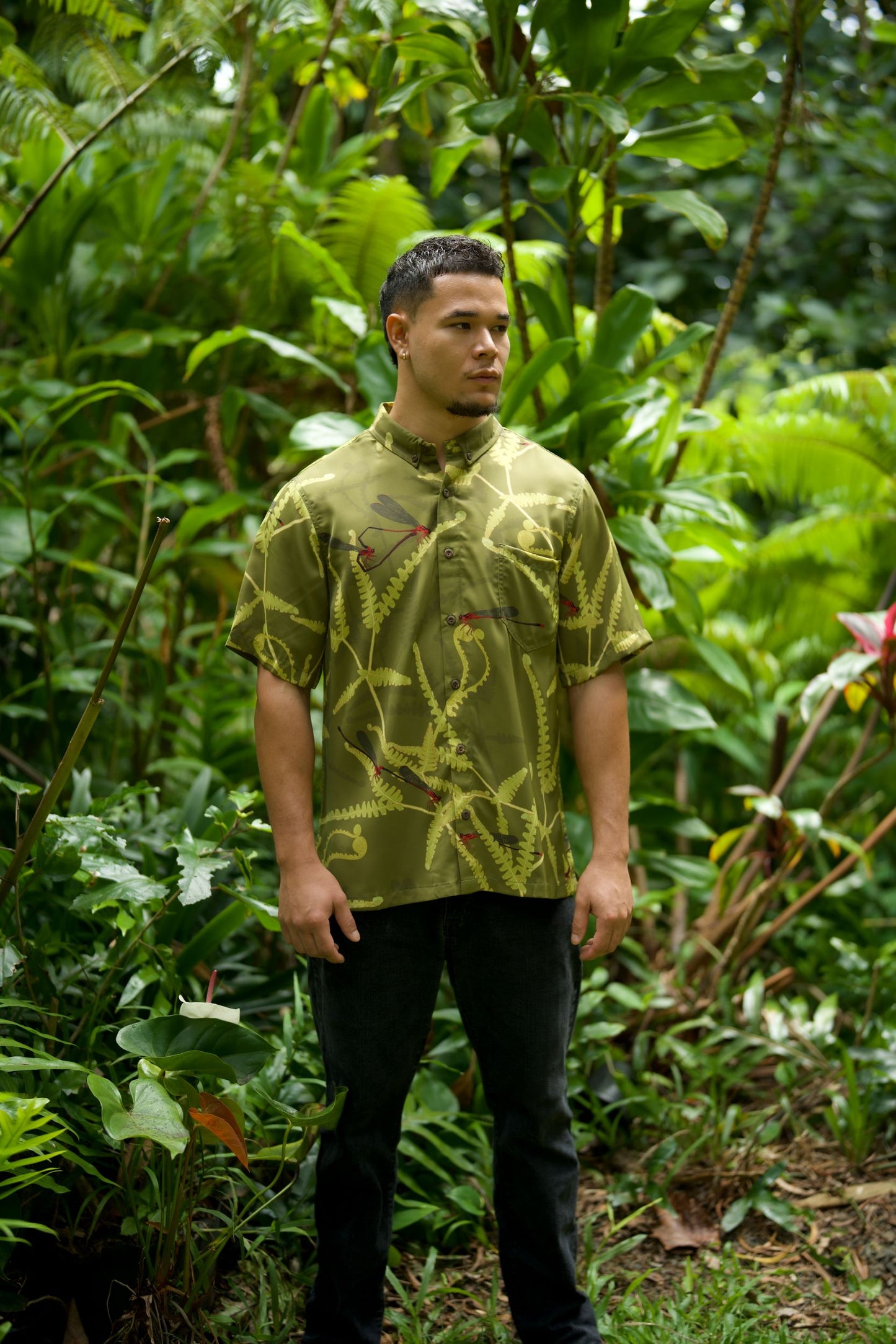


Hawai'i is home to about 25 species of pinapinao (damselflies), all in the genus Megalagrion. Pinapinao are increasingly rare, and many have been pushed to near extinction. The immatures (naiads) of most pinapinao are aquatic, and highly susceptible to predation by nonnative fish and frogs.
The Hawai'i Invertebrate Program, a division of the Hawai'i Department of Land and Natural Resources, rears some pinapinao species in captivity for reintroduction to fish-free streams and pools. You can help by supporting efforts to restore aquatic habitats, never releasing aquarium fish or other aquatic animals into the wild, and always thoroughly cleaning footwear and gear before hiking near streams to avoid transporting harmful microorganisms.
The species illustrated here, Megalagrion oahuense, is unusal because its naiads are not aquatic, living instead in leaf litter that accumulates under mats of uluhe, an indigenous fern that grows densely over ridges and valleys. Naiads of this species have only been observed a handful of times, though the adult damselflies can be seen flying along summit ridges of O'ahu. Terrestrial damselfly naiads are an evolutionary anomaly, found almost nowhere else in the world!
To learn more about the Hawai'i Invertebrate Program, visit: